

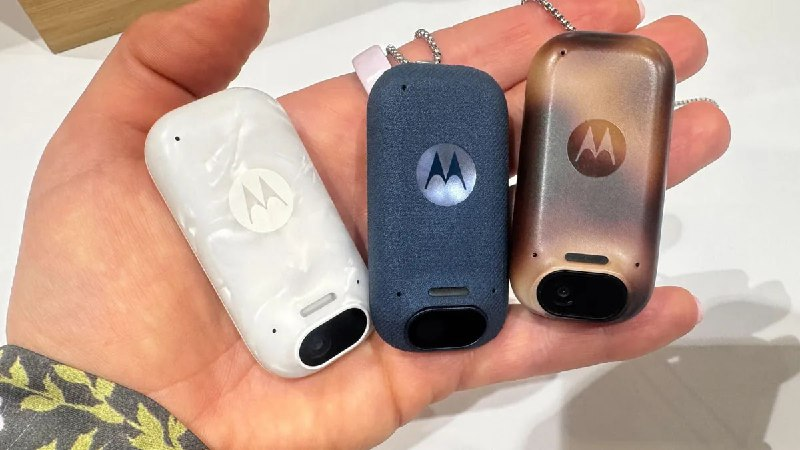
Little Brother
At the MWC 2026 exhibition, Motorola introduced Project Maxwell — a wearable AI brooch that the company is using as an experimental platform for “background” personal artificial intelligence. This device, equipped with a camera and microphones, is designed to capture everything happening around it, assist in object recognition, and function within a broader AI ecosystem from Lenovo and Motorola, rather than serving as an independent gadget.
The idea behind Maxwell is to make AI less “screen-based” and more contextual. That is, assistance should come not through constantly opening applications but via continuous background perception of the environment, voice commands, and the overall situation.
Following the failure of Humane AI Pin, interest in creating compact devices remains strong. Anticipation of new secret gadgets from OpenAI and other companies clearly indicates a trend toward miniaturization and integration of AI into wearable devices.
Motorola positions its project simply as eyes and ears, with data processing handled by their AI assistant Qira. For example, one scenario involves looking at a menu with hundreds of items in Chinese, and the AI instantly recognizing the text, translating it, and vocally indicating what is edible and what is not.
This “little brother” carefully transmits information to its “older sibling,” that is, Big Brother. It’s no longer surprising that our gadgets listen through microphones; now such ideas extend further — they can read not only sounds but also what we see around us.
Concepts like these are familiar from series such as “Black Mirror” — for example, eye lenses that record everything happening. Prototypes already exist. However, it seems they should be made even smaller — perhaps glued or embedded directly into a third-eye location (especially relevant in India). This way, there would be no need to carry smart brooches or glasses.
Created with n8n:
https://cutt.ly/n8n
Created with syllaby:
https://cutt.ly/syllaby