

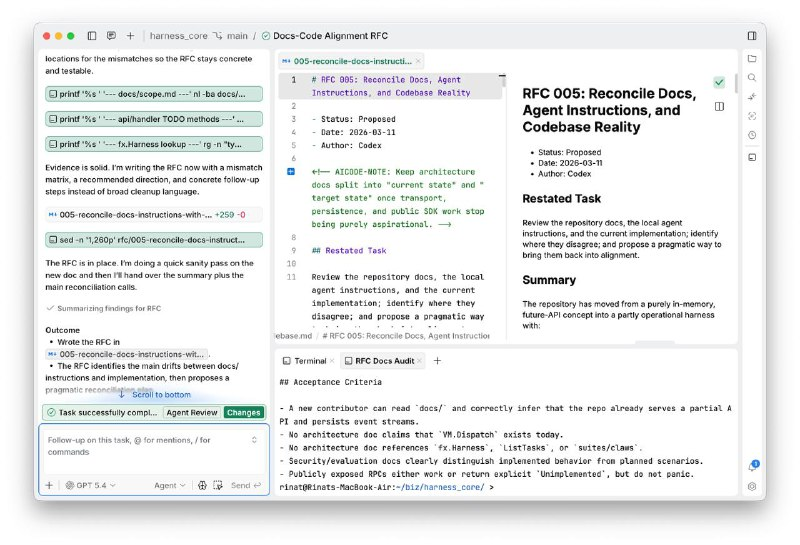
JetBrains introduced their version of the interface for working with Codex — now it can be connected to an OpenAI subscription, as well as to Gemini CLI or Anthropic API.
The new release is called JetBrains AIR.
It’s a pretty interesting solution — visually, it looks smoother and more pleasant. It operates faster than the previous Codex Desktop, but not because the models have become quicker, rather because the interface has become more responsive and doesn’t lag. As a result, the user experience has become much more comfortable. Additionally, more settings have been added under the hood, providing greater flexibility. However, in early stages, some minor bugs are barely noticeable.
I will periodically test this environment in my workflow, but I don’t have high expectations. The main issue with OpenAI Codex for me isn’t delays or configuration inconveniences — those are secondary. The key is to make the right architectural and product decisions quickly, within a single workday or even less.
It’s also unlikely that AIR will become the next Cursor.sh or Perplexity — projects that try to compete with major players like OpenAI, Anthropic, or Google. Such competitors often can’t sustain a price war and set limits that drive users to platforms where working is simpler and more straightforward.
Created with n8n:
https://cutt.ly/n8n
Created with syllaby:
https://cutt.ly/syllaby