

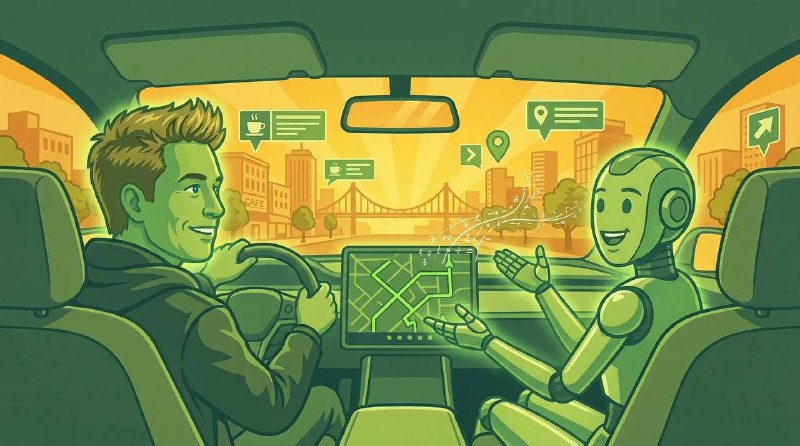
Imagine a situation: you’re preparing for a trip, opening Google Maps — and instead of your usual route from point A to point B, something new appears. Gemini is integrated directly into the map and ready to answer any questions — where to stop, what to try along the way, which turn to take for convenience, or which route to choose if parking or minimizing time at junctions is important.
But Google didn’t stop there. The company introduced the Immersive Navigation feature — now you can preview a 3D version of your route in advance. It displays buildings, bridges, crossings, and all those urban details that often cause people to take wrong exits and then waste an extra 20 minutes. The map gradually transforms into a digital guide, “running” the route before you even leave home.
What’s inside?
Google has updated Maps and integrated its AI model Gemini — the very artificial intelligence that is now actively added to all major company products.
The first feature — Ask Maps. Here, users can ask any questions in simple language, and the system responds based on a database of over 300 million places and reviews.
The second — Immersive Navigation. It creates a three-dimensional view of the route by analyzing Street View and satellite images. As a result, you see not only the road but also buildings, junctions, bridges, and other characteristic city details.
Additionally, Maps now features more conversational voice prompts, previews of destinations via Street View with parking information, and explanations of alternative routes.
Previously, Google integrated Gemini into services like Gmail, Docs, Sheets, Drive, Meet, Photos, and Android. What’s the idea? Not waiting for new AI services to appear — the company prefers to embed them directly where users spend their daily time.
And what does this lead to?
Google has a very strong advantage here. While other companies compete for the best chat or AI benchmarks, Google integrates AI directly into familiar usage scenarios — emails, documents, calls, maps, or trips. The giant has access to billions of users without the need for separate installation or training on new software. For the market, this means a trend toward built-in AI becoming the default standard. For businesses, standalone AI products become less protected: their features are easily integrated into existing mass services. The main focus now is on spreading the technology, collecting data, and everyday use.
🚨 Really risky:
For startups in travel planning and navigation interfaces, the situation becomes challenging — 9 out of 10 competitors risk losing a significant user base because Google already has maps, reviews, traffic data, and the habit of opening Maps automatically. What to do? Focus on niche scenarios with detailed development; create B2B solutions for logistics or on-site teams; accumulate unique data outside the Google ecosystem; offer solutions with clear ROI.
If you want to understand how a digital employee works and the architecture of an AI agent — join us on March 18 at 18:30 CET for our Open House in the BIPIAI community. We will explore how the system is built: how the agent functions, memory, tasks, and workflows for full business support with AI. Participation is free! Register via the link — don’t miss it!
Created with n8n:
https://cutt.ly/n8n
Created with syllaby:
https://cutt.ly/syllaby