

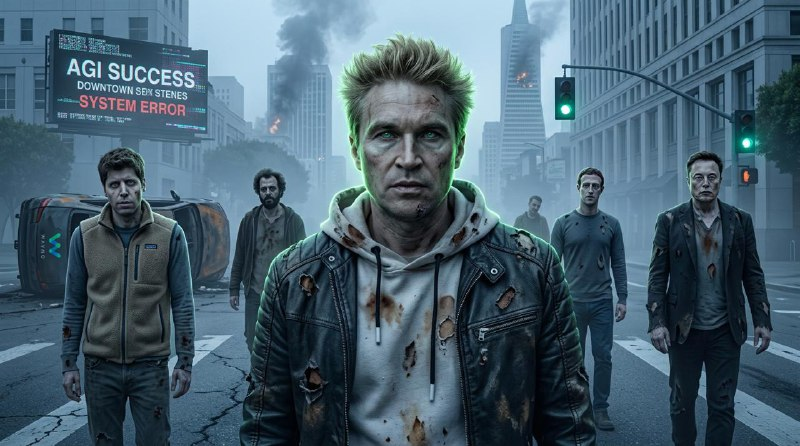
Friday the 13th.
Usually, on such a day, people are scared with horror stories, Freddy Krueger, or cheap horror movies.
But today I decided to scare you for real — without masks, bravado, or scary scenes. Because the changes happening right now thanks to artificial intelligence are much more impressive and dangerous.
AI is already integrating into our lives so rapidly that most people don’t even notice how quickly the world around us is changing. In recent months, it has become clear: this is not just about funny images or assistance with daily tasks. It’s about how AI is taking over finance, jobs, security, trust, and even military conflicts. And this is just the beginning.
Here are ten key trends from February and March that I consider particularly important.
First — AI is already taking jobs.
For example, Jack Dorsey announced layoffs of over four thousand employees. Following this, his company’s stock rose by about a quarter. Reuters reports that since November, the number of layoffs related to AI and automation has exceeded 61,000.
Second — AI significantly reduces labor costs.
What was previously done by humans is now performed by powerful AI solutions. Companies are cutting expenses, increasing efficiency, and restructuring business processes around an “AI-first” model. Reuters directly links these changes to a new wave of layoffs expected in 2026.
Third — AI is stealing money.
Expertise now includes forecasts of using autonomous AI systems for fraud: deepfake videos, cloning websites, and malicious bots with emotional intelligence. Considering losses from fraud amounting to approximately $12.5 billion annually, this is already a criminal market.
Fourth — scaling fraud to an industrial level.
According to Experian, around 4% of all checks in 2025 were fraudulent. Media based on AI was used in attacks 300% more often compared to the previous year. A full-fledged conveyor belt of criminal schemes is already underway.
Fifth — AI undermines trust in hiring processes.
Deepfake candidates for jobs have become a major future risk. Now, employers must not only review resumes and portfolios but also verify if the person is real and alive in front of a camera.
Sixth — AI’s speed surpasses human capabilities.
People think, write, and verify slowly and get tired. Autonomous systems and automated fraud schemes work around the clock tirelessly and without delays. As a result, attacks accelerate, and the volume of operations grows exponentially. Experts’ reports confirm this.
Seventh — AI is already involved in military affairs.
The conflict between Anthropic and the Pentagon showed that frontier models are discussed as tools for defense purposes. Today, it’s not just about text assistants or data analysis — it’s a layer of technology with potential military applications and limits on permissible use.
Eighth — the topic of total surveillance has come to the forefront.
In the dispute between Anthropic and the Pentagon, the issue of surveillance via AI surfaced: using such systems to monitor citizens or opponents raises serious concerns. This question is becoming part of political dialogue about the boundaries of government intervention.
Ninth — infrastructure is becoming increasingly critical for AI operation.
After attacks on regions, AWS reported outages at data centers in Bahrain and the UAE: power failures, fires, and service disruptions. When AI relies on cloud infrastructure, any strike against it immediately impacts businesses and users.
Tenth — control over technologies is taking on a political dimension.
When major AI companies are arguing with governments not about functions or interface convenience but about access rules and restrictions — it signals a power struggle. Technology is turning into a key political asset.
All these topics were thoroughly discussed at our BIPIAI CONF conference held from March 3 to 5.
Participants have already received lecture recordings and materials by email.
Over ten hours of information will help you completely update your understanding of the current state of artificial intelligence this weekend.
It covers stories about agents and new productivity,
discussions on vibe-coding and the labor market situation,
security and trust,
what is happening now in business,
and where we are heading in the coming months.
If you registered earlier — check your email again.
And if you just found out about the event now — that’s fine too! Just follow the link below, leave your email — all materials will be sent directly to your inbox.
Created with n8n:
https://cutt.ly/n8n
Created with syllaby:
https://cutt.ly/syllaby