

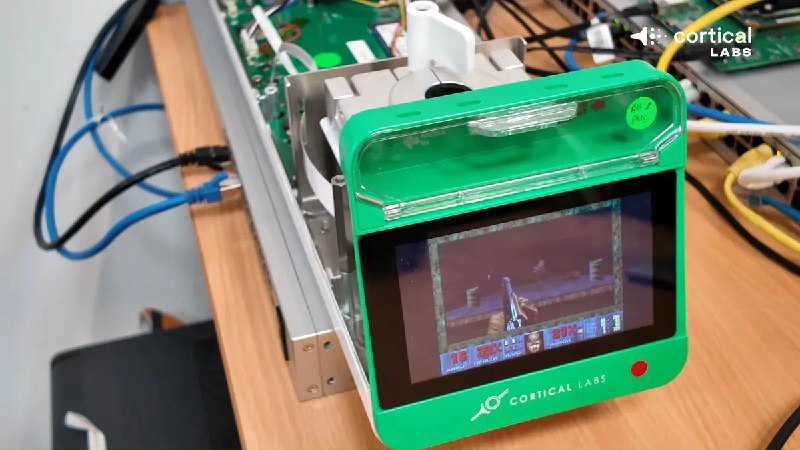
Here’s an interesting case that shows how far experiments with living neurons have come. Australian startup Cortical Labs demonstrated how their biological computer—a chip in which human neurons grown from stem cells are cultivated—plays Doom. And yes, it doesn’t just simulate the game or emulate brain activity—these living cells actually look at the screen, perceive what’s happening through electrical signals, and make decisions: to shoot or to run away.
Of course, neurons don’t have eyes or hands. They somehow “coded” visual data from the game (the appearance of monsters, walls, and everything else) directly into electrical stimuli. Basically, they are stimulated back and forth with current: as soon as an enemy appears on the screen, the chip sends a charge to a specific part of the neurons. These cells respond and generate a corresponding electrical pattern. A special interface decodes these signals using “neural coding”—the patterns mean “move forward” or “fire.”
The cells try to minimize, roughly speaking, pain or irritation (acting as stimulators) and adjust their connections to survive in the game process. They only needed a week to learn.
The project leader says that the neurons are still playing very poorly—as if a beginner who has just seen a monitor for the first time: they keep dying. But the most important proof is that these cells are capable of learning during gameplay. They already understand how to find enemies and shoot at them. And everything should get better from here.
Why are people doing this at all? Not for fun. The main issue with modern artificial intelligence is its incredible energy consumption. Silicon data centers require hundreds of megawatts of power and massive cooling systems. Meanwhile, the human brain with 86 billion neurons operates on just 20 watts—like a regular light bulb! Therefore, such experiments are an attempt to create AI that learns faster than silicon systems and consumes almost no energy.
These are very important studies—achievements in this area could radically change approaches to AI. Today, 200,000 living neurons shoot at pixelated demons in a game, but tomorrow, millions of such cells could control robots or assist in medical data analysis.
And if you’re interested, here is the article and video.
P.S.: And yes—I included the word “coded” sarcastically… just to clarify for those who might have thought otherwise.
Created with n8n:
https://cutt.ly/n8n
Created with syllaby:
https://cutt.ly/syllaby