

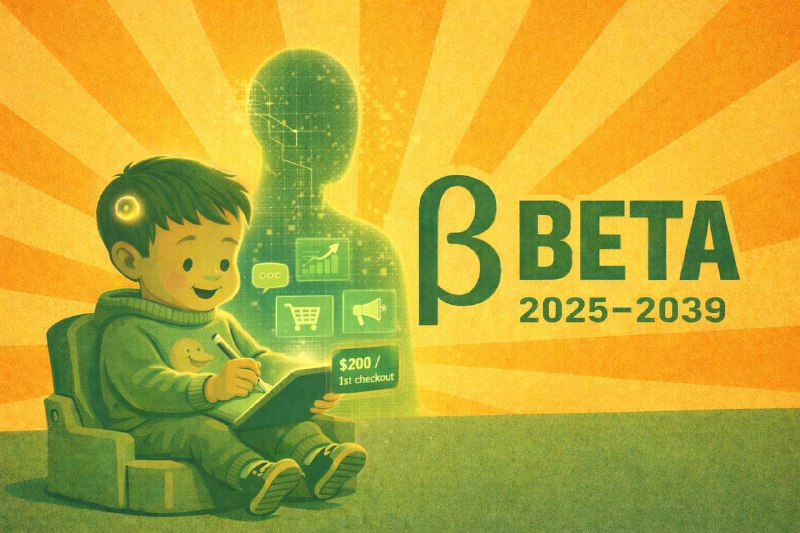
2005 is a thing of the past, and by 2025 a new race has already begun, which adults somehow try not to notice. And it’s a mistake.
From this moment, the Beta generation (2025–2039) emerges. One could say these are the first children for whom artificial intelligence will become a familiar environment: how to turn on the lights, how to ask, and how to get the desired result—all of this begins with a dialogue with AI, not with installing apps.
Briefly reviewing the evolution of the previous two generations: Zetties (Gen Z) grew up alongside the internet and social media—they got used to being public, created profiles, learned platform rules, navigated information noise, searched for and compared information. Alphas (Alpha) grew up on screens and endless feeds: their attention was held by clips, recommendations, and fast content streams. And now—Beta. These little ones will start receiving content and education tailored to specific queries from an early age: personalized learning, creating their own mini-projects, automating simple tasks.
The pace of development, real-life examples, characters, complexity levels, and repetition— all of this will become familiar even before they go to school. The skill “asked → clarified → received a plan → implemented → checked” will become standard.
And now—a bad news for adults over 40. Your own role will soon change: your children will start becoming your competitors sooner than you realize.
First—competition for learning speed. Those little ones who receive personalized explanations, practice, and feedback daily will quickly master important skills: languages, logic, math through problem-solving, content creation, and building simple projects with ready-made tools. By age 6–7, a child will be able to set tasks for systems, receive solution options, and make choices.
Second—competition for results. Gen Z learned to search for information; Alpha actively watched videos; and Beta will be collecting presentations, voicing characters, creating small games or school projects—all automatically and easily. Barriers like “I don’t know how” will soon disappear entirely. Only “I don’t know exactly what I want” or “I don’t finish things” will remain. And most adults often find themselves in this situation.
Third—competition for attention and influence. Now AI-powered toys are turning into real friends and companions: they remember preferences, support conversations, and adapt to the child’s mood.
Meanwhile, schools will waver between different approaches: some block neural network use; some impose strict rules; some pretend nothing special is happening. As a result, children will learn to live in two modes: officially “not allowed,” but in practice using everything possible. This trains skills in bypassing rules and independently obtaining information.
At the same time, the system itself is experiencing stress: it doesn’t know exactly how to regulate this process properly. Some countries have already limited social media for teenagers up to age 16; others publicly announce similar measures.
When a government tries to control age restrictions—that’s a signal of only one thing: adults are losing the battle for children’s attention.
Imagine the future: a five-year-old tells the system: “I want to earn 200 euros with my idea,”—and then builds a whole micro-business chain. AI helps choose a topic based on interests (dinosaurs or football), come up with a product (coloring books or mini-books), write texts, and create images. It assembles a landing page via a website builder and connects payment options. It creates a marketing funnel and plans short videos—about twenty in total—and even calculates simple unit economics: how much it costs to acquire a customer or what profit margin is achieved from sales.
Next, it launches the project, monitors purchases, changes packaging or offers, and repeats the cycle. All of this is absolutely feasible for an ordinary child without special talents or connections: tools automate the heavy part of the process—while the child focuses on task setting and iterations.
Speaking of early starts—remember Mozart! By age three he was already playing keyboard instruments; at four he mastered the violin; and his first public concert was around five and a half years old. But the main point now is that such incredible opportunities will become accessible to many more children. When “early” used to mean rare talent or a special environment for development—now it can become a reality for almost every kid.
The continuation in the next comment.
Created with n8n:
https://cutt.ly/n8n
Created with syllaby:
https://cutt.ly/syllaby