

Imagine this: a camera in a warehouse records a box, a bottle, and even a cat, and immediately finds a connection — it’s a beast, it’s glass, it’s cargo. In this way, by analogy, a neural network already thinks. Scientists from China have discovered that its perception method resembles brain activity.
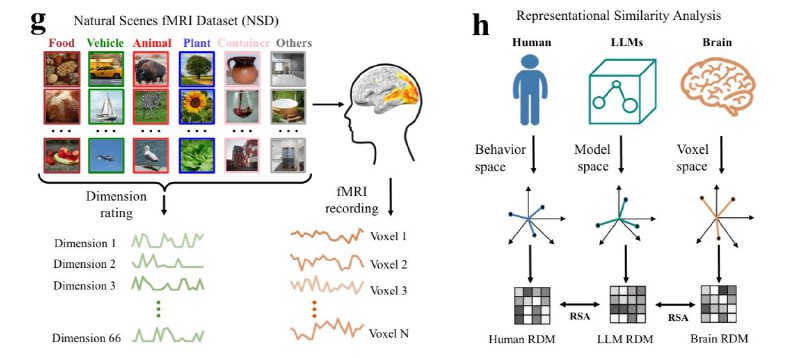
They were shown nearly two thousand common objects, all packaged into millions of tests with a simple task: select the “odd one out” from three images. The model had to understand what was wrong and discard the unnecessary item. After each test, experts recorded the state of the network’s internal layer — resulting in a vast cloud of points that grouped themselves into 66 dense clusters. One cluster contained animals, another vegetables and fruits, a bit further were tools, then transport, furniture, and clothing.
Then, everything was compared to the reaction of the human brain. The test was conducted using fMRI — volunteers were shown the same images. It turned out that the activity in the temporal cortex very precisely matched how the internal layers of the neural network responded. In places where certain areas of a person’s brain lit up upon seeing a cat or a banana, the network also displayed similar activity, ignoring, for example, a bus if it was irrelevant. The result was astonishing: the model did not just memorize pixels but developed its own set of concepts — almost like our brain.
Here are a few real-world examples of applications of such technology:
– In an online marketplace, a new product card automatically gets categorized correctly — recommendations are precisely tailored without manual adjustments.
– In a warehouse, a transport robot recognizes a fragile jar and handles it carefully, even without specific instructions.
– In agriculture, a drone can distinguish weeds from cereals based on meaning, reducing the need for chemicals.
– In medicine, an MRI model helps quickly identify signs of tumors, speeding up initial diagnosis.
– In intrusion detection systems, traffic is instantly classified as normal or potentially dangerous, even before characteristic signatures appear.
And the conclusion is: artificial intelligence relies less and less on memorizing individual pixels and more on its own “alphabetical” conceptual system. This approach helps businesses save on data labeling and obtain understandable, explainable solutions. Developers can flexibly tailor these systems for specific tasks — whether in healthcare, finance, or inventory management. The next step is creating services that visualize these internal maps, ensure their security, and finely tune them to client needs.