

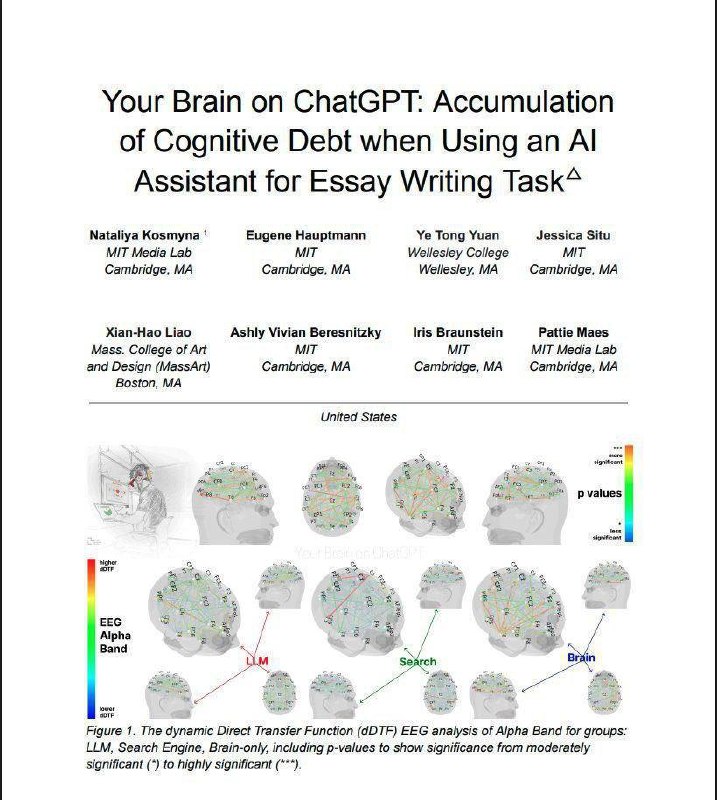
I have already mentioned how artificial intelligence is increasingly interfering in the educational process, and even during the Chinese gaokao exam, it was decided to simply turn it off so it wouldn’t interfere. Until recently, there was no clear data on what exactly neural networks do to the human brain. But finally, MIT conducted a study—and the conclusion was unequivocal: without much effort, we are indeed beginning to lose mental abilities.
Here’s how the experiment was conducted. Students were divided into three groups: one solved tasks and read texts as they were. The second could use search engines and online resources. And the third interacted with a chatbot. While the participants worked—reading, answering—their brains were scanned. Afterward, everyone was given a new task and asked to retell what they had read.
What were the results? The most active brain activity was observed in those who managed without external help—the “manual” group. Those who googled showed about one-third less activity. And those who used AI—almost half of the connections disappeared. At the same time, memory retention decreased by 83%: people could hardly convey the content of the text and slowly switched to new tasks.
So, what does all this imply?
Firstly, starting work with prompts harms memory and breaks the chain of reasoning. As a result, companies receive only a ready-made answer, but no deep understanding of the issue.
Secondly, in business, it’s better to follow a scheme: first brainstorm ideas or solutions mentally, then verify them through a model or algorithm. Otherwise, employees become mere operators copying and repeating others’ thoughts.
Thirdly, investments are increasing in so-called cognitive “fitness services”: various tools for training memory and checking genuine understanding. There are also more solutions emerging to protect against AI “hallucinations”—errors and perception mistakes made by the model.
And in everyday life, there’s a simple rule: think for yourself first, then seek help from artificial intelligence.