

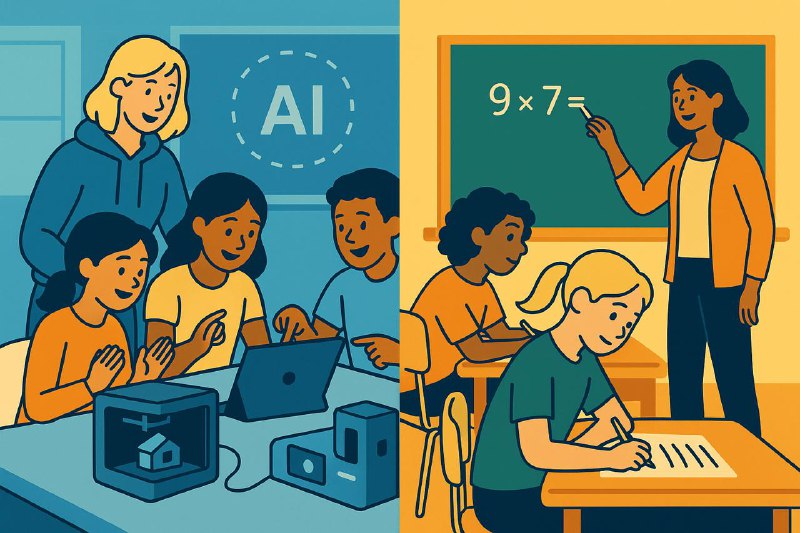
In London, right across the street, there are two sixth-grade classes—one at a private school and the other at a public school.
In the first—which is an elite school—the teacher opens ChatGPT and asks the students to come up with a medieval-themed quest. Within a minute, the entire class is running through the corridors, solving riddles with QR codes. Half of the children are already working with image generators on their iPads, creating castles for a math project. Here, they face a technological gap: some use the latest tools, while others have only heard about AI.
In the second class—an ordinary school—the lesson remains the same. The teacher draws castle diagrams with chalk on the board. Among the students, only one in six has ever tried AI, and the rest haven’t even seen it in action. One boy completely refused to use neural networks after reading about how much water is needed to cool data centers.
According to a recent study by the Turing Institute, about half of children in elite schools regularly use AI—around 52%. In public schools, this figure is roughly 18%. Teachers at private schools create lesson plans, prepare presentations, and assign homework with AI. Public school teachers are aware of such technology but often lack the time and devices. Environmental concerns especially slow down adoption: some students stop using chatbots as soon as they hear about the liters of water required to cool data centers.
What’s next?
It turns out that the gap in access to AI is creating a new line of division. Platforms that facilitate AI integration into schools—like offering offline modes, subsidies, and eco-friendly reports—will help reach a broader audience and improve the institution’s reputation.
Where to find a source of revenue? Subscriptions for “AI skills” content for classrooms are quickly evolving into SaaS—long-term systems with ongoing value, since the school year is lengthy and there are many upselling opportunities: projects, quests, languages, creative tasks. But this won’t last long; a new model will soon emerge.
As for the future of HR—those who have already grown up using generators will learn to eliminate routine tasks with a single prompt and move immediately to more complex problems. Others will continue learning through corporate programs, increasing expenditure on training and development.
Investor perspective: focus on startups that do not just offer another flashy platform but develop methodologies. For example, drafting content manually, then verifying it with AI and analyzing mistakes. This approach fosters the habit of thinking critically rather than simply copying.
AI truly expands creative horizons in seconds, but the brain learns according to the classic principle—repetition, errors, and practice. If a child immediately relies on neural networks, their muscle memory remains weak. We are at a crossroads: either we create a harmony of manual methods and AI to boost brain function or end up in a scenario of “idocracy,” where answers arrive instantly and no one can verify their accuracy.